




Vintage engagement ring styles by era
Art Deco engagement rings (1920s–1930s)
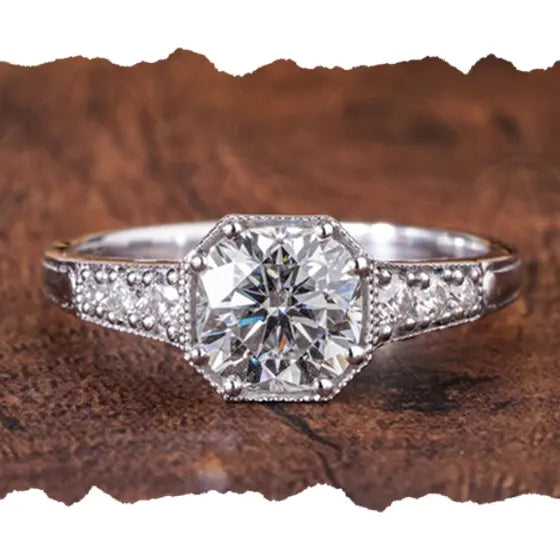
Art Deco design took over in the 1920s and 1930s and turned away from the soft curves before it. Think straight lines, mirror-image symmetry, square and step-cut shapes, and pierced openwork. On a ring, that usually means a square or rectangular halo, baguette accents, or engraved lines along the band.
Choose it if you like an architectural look that still feels dressy. Angular designs sit wider on the finger, so check the width against any band you plan to stack.
Shop Art Deco rings Art Deco Bezel Set Round Split Shank Engagement RingView this ring
Edwardian engagement rings (c. 1901–1915)
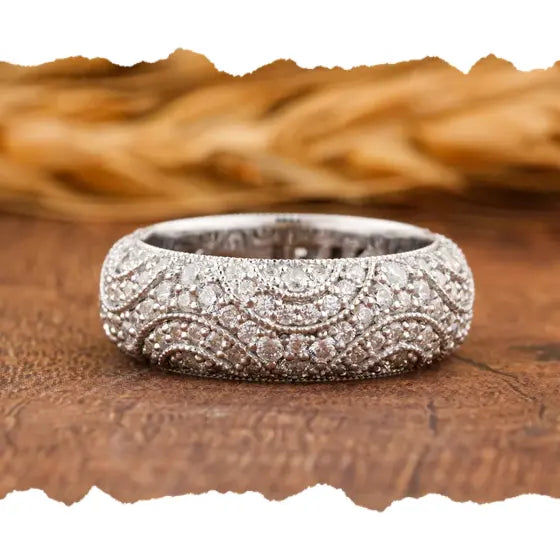
Edwardian rings are the opposite mood: light, lacy and romantic. Fine filigree, milgrain edges, soft curves and garland-style details give the metal a delicate, almost woven look. Our Edwardian-style Toi et Moi ring shows how two stones and beaded edges work together.
Choose it if you love fine detail and an heirloom feel. Openwork traps dust, so a soft brush and mild soapy water keep it crisp.
Shop Edwardian rings Vintage Edwardian Oval Moissanite Engagement Ring with FiligreeView this ring
Vintage engagement ring styles by detail
Milgrain engagement rings
Milgrain is a row of tiny metal beads along the edge of a setting or band. It’s a detail, not an era, so it can appear on almost any shape: round, oval, cushion, or emerald. The beads frame the stone and add texture that smooth metal can’t. Our guide to what milgrain is covers how it’s made.
Choose it if you want an antique feel without a heavily ornate ring. Over years of daily wear, the beads can soften, and a jeweler can refresh them.
Shop milgrain rings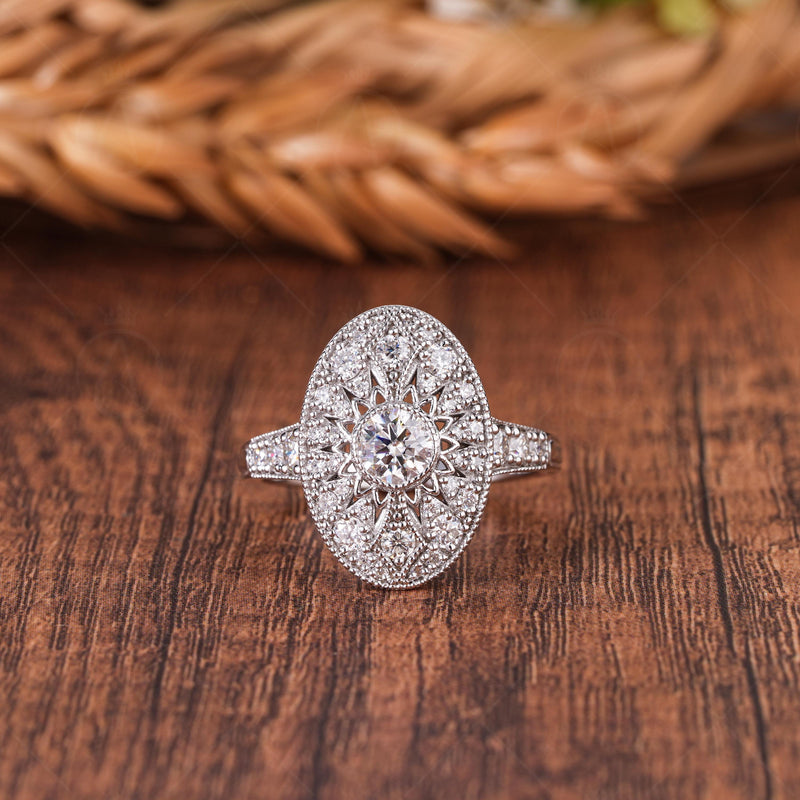 Openwork Art Deco Vintage Oval Milgrain Moissanite Engagement RingView this ring
Old European cut engagement rings
The Old European cut is an antique round cut from the Victorian and Edwardian eras. Compared with a modern brilliant, it has larger facets and a smaller table, which gives broader, softer flashes of light instead of a crisp, icy sparkle. Our versions recreate that look in moissanite.
Choose it if you prefer a warm glow to laser-sharp brilliance. The cut looks noticeably different in motion, so check the photos and video on the product page before you decide.
Shop Old European cut rings Antique Old European Cut Cushion Cut Engagement RingView this ring
Vintage engagement ring styles by setting
Vintage halo engagement rings
A vintage halo surrounds the center stone with a ring of smaller ones. Antique halos often go beyond a plain circle: square, cushion, or a double halo with two rings, as in our 1930s-inspired oval. The extra stones make the center look larger and add glow without raising the carat weight.
Choose it if you want presence. Higher, wider halos can catch on knitwear, so low-set versions suit busy hands better.
Shop halo rings 1930s Inspired Double Halo Oval Engagement RingView this ring
Cluster engagement rings
A cluster groups several stones of similar size so they read as one larger, flower-like jewel. It’s a long-running antique idea, and it builds the impression of a big gem from smaller stones.
Choose it if you like florals and a jewel-box look. With many small prongs, it’s worth having a jeweler check them once a year.
Shop cluster rings Celebrity Inspired Vintage Cluster Engagement RingView this ring
Side stone engagement rings
Side-stone rings flank the center stone with smaller stones on the shoulders of the band. The sparkle runs down the finger and leads the eye to the middle, which gives a balanced, polished look. In vintage versions, the side stones are often baguettes or tapered cuts that echo Art Deco’s straight lines.
Choose it if you want extra sparkle that looks refined rather than flashy. Stones set down the band make resizing more limited, so measure carefully with our international ring size chart.
Shop side stone rings Yellow Oval Moissanite Vintage Inspired Engagement RingView this ring
Three stone engagement rings
A three-stone ring pairs a center stone with a matching stone on each side. Many couples read it as past, present and future. The symmetrical layout feels stately, and with milgrain or filigree it takes on a distinctly antique character.
Choose it if meaning matters to you. The layout is wider across the finger, so think about your lifestyle and any wedding band you want to pair with it.
Shop three stone rings Three Stone Emerald Cut Vintage Engagement RingView this ring
Vintage solitaire engagement rings
A vintage solitaire keeps one stone and lets the details carry the design: an engraved band, a tulip-shaped head, milgrain edges, or leaf motifs. It’s the quietest style here, but not the plainest.
Choose it if you want an everyday ring with character. A low setting is the most practical for hands-on work, and the slim profile pairs easily with curved and contour wedding bands.
Shop solitaire rings Vintage Style Moissanite Engraved Round Cut Solitaire Engagement RingView this ring
Quick comparison of the nine vintage styles
| Style | Look | Signature details | Best for | Keep in mind | |
|---|---|---|---|---|---|
 |
Art Deco | Bold, geometric, symmetrical | Square and step-cut shapes, baguettes, engraved lines | A graphic, retro-modern taste | Angular designs sit wider on the finger |
 |
Edwardian | Delicate, lacy, romantic | Filigree, milgrain, soft curves | Fine detail and an heirloom feel | Openwork needs gentle cleaning |
 |
Milgrain | Beaded, antique | Tiny metal beads along the edges | Antique texture on any stone shape | Beads soften over years; a jeweler can refresh them |
 |
Old European cut | Warm, broad sparkle | Larger facets, smaller table | A soft glow over icy brilliance | Looks different in motion; check the video |
 |
Halo | Glowing, larger-looking center | Single, double or shaped halos | Maximum presence | Tall, wide heads can catch on knitwear |
 |
Cluster | Floral, jewel-like | Several stones grouped as one bloom | A big look from smaller stones | Many prongs; get them checked yearly |
 |
Side stone | Balanced, polished | Smaller stones on the shoulders | Sparkle that runs down the finger | Resizing is more limited |
 |
Three stone | Stately, symbolic | Center stone plus a matching pair | Meaning-driven choices | Wider across the finger |
 |
Solitaire | Pure, understated | Engraved bands, tulip heads, milgrain edges | Everyday wear with character | The cut and engraving carry the design |
How to pick your vintage engagement ring style
- Want it to look genuinely antique: start with Edwardian, then add milgrain.
- Want bold and graphic: choose Art Deco.
- Want the most visual impact: look at halo or cluster rings.
- Have active hands or a job that’s tough on rings: a low-set solitaire is the safest bet.
- Want symbolism: a three-stone ring tells a story.
- Planning to stack bands: check the vintage wedding bands that fit your ring’s shape.
Then choose a stone shape: oval looks elongated on the hand, round is the classic, cushion feels soft and romantic, and emerald is clean and architectural.
Vintage-inspired, not antique
Vintage engagement ring styles: FAQ
Can one ring combine several vintage styles?
Yes, and most do. Common mixes are an Art Deco halo with milgrain edges, or an Edwardian solitaire with filigree. Treat the nine styles as a vocabulary rather than separate boxes.
Are these rings original antiques?
No. They are new rings inspired by Art Deco, Edwardian, and other eras, so you get the antique look with new, durable stones and a 30-day return window.
What is the difference between Art Deco and Edwardian rings?
Edwardian rings are delicate and lacy, with fine filigree and soft curves. Art Deco rings are bolder, with strong geometry and sharp lines.
Which style is best for everyday wear?
A low-set solitaire, ideally with milgrain or engraving for character, snags the least. Tall halos and clusters look dramatic but catch more easily.
Which vintage style looks biggest?
Halo and cluster rings, because the surrounding stones extend the visual footprint of the center. An elongated shape such as oval or marquise also reads larger than a round stone of the same weight.
See every style in one place
All nine styles are in our vintage engagement rings collection, ready to ship worldwide with 30-day returns.
Browse vintage engagement rings

